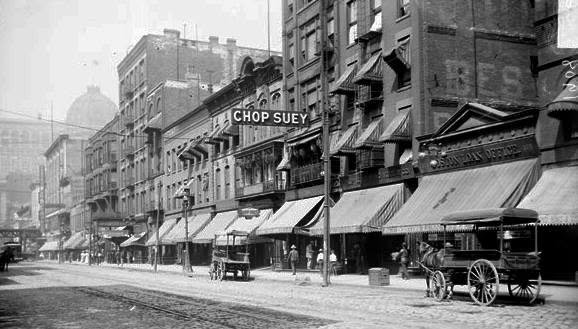
This page gives historical background. The Clark Street area lies outside the proposed Chinatown landmark district, and its buildings are not part of the survey map.
Clark Street and Van Buren
According to one early account, Chicago’s Chinese community began in the mid-1870s, when T. C. Moy (also known as Moy Dong Chow) arrived from San Francisco and opened a shop near Clark Street and Van Buren Street. Moy’s letters home are said to have drawn dozens of relatives and friends to the city, and Chinese businesses soon clustered along South Clark Street. Chicago’s Chinese population grew from 172 in 1880 to 1,179 in 1900.
By the late 1870s, a small Chinatown had formed on Clark Street between Van Buren and Harrison Streets, close to the Van Buren Street railroad depot. By 1889, the Chicago Tribune counted grocery stores, drugstores, butcher shops, barbershops, a cigar factory and a restaurant in the area. The neighborhood bordered a stretch of South Clark Street known as “Little Cheyenne” for its saloons and gambling houses, a reputation that also shaped how outsiders saw Chinatown.
A community above the shops
Much of community life took place above and around the storefronts. A single business might combine a store, lodging, a restaurant, an employment office and access to credit. Moy Dong Chow’s Hip Lung Yee Kee store, which moved to 323 S. Clark Street in the 1880s, served as a social and commercial anchor for the district.
Three kinds of organizations took shape: family associations based on shared surnames or home villages; merchant associations, or tongs, such as the On Leong Merchants Association (established 1905 at 292 S. Clark Street) and its rival, the Hip Sing Association (1900, 355 S. Clark Street); and political groups that followed reform and revolutionary movements in China. Churches were present almost from the beginning, starting with a Baptist mission and Sunday school that opened above a storefront at 295 S. Clark Street in 1876.
These organizations responded to a largely male immigrant society that, under the Chinese Exclusion Act and widespread discrimination, could not rely on mainstream institutions for work, credit, dispute resolution or representation.
In his oral history, Leslie Moy traced his own family to this period: his grandfather, Moy Dung Yee, followed older brothers from Toisan by way of San Francisco and reached Chicago in 1878, where the family ran trading businesses near Clark and Van Buren. Read more in Moving south.
The move south
By the early 1910s, the land under the Clark Street community was in demand for larger downtown buildings. Rising rents, redevelopment and racial discrimination left Chinese residents with little say over the neighborhood’s future, and rivalry between the On Leong and Hip Sing associations may also have played a part. In 1912, On Leong leaders began moving the community to 22nd Street (now Cermak Road) and Wentworth Avenue in Armour Square, where buildings were available, schools were nearby and there was room to grow.
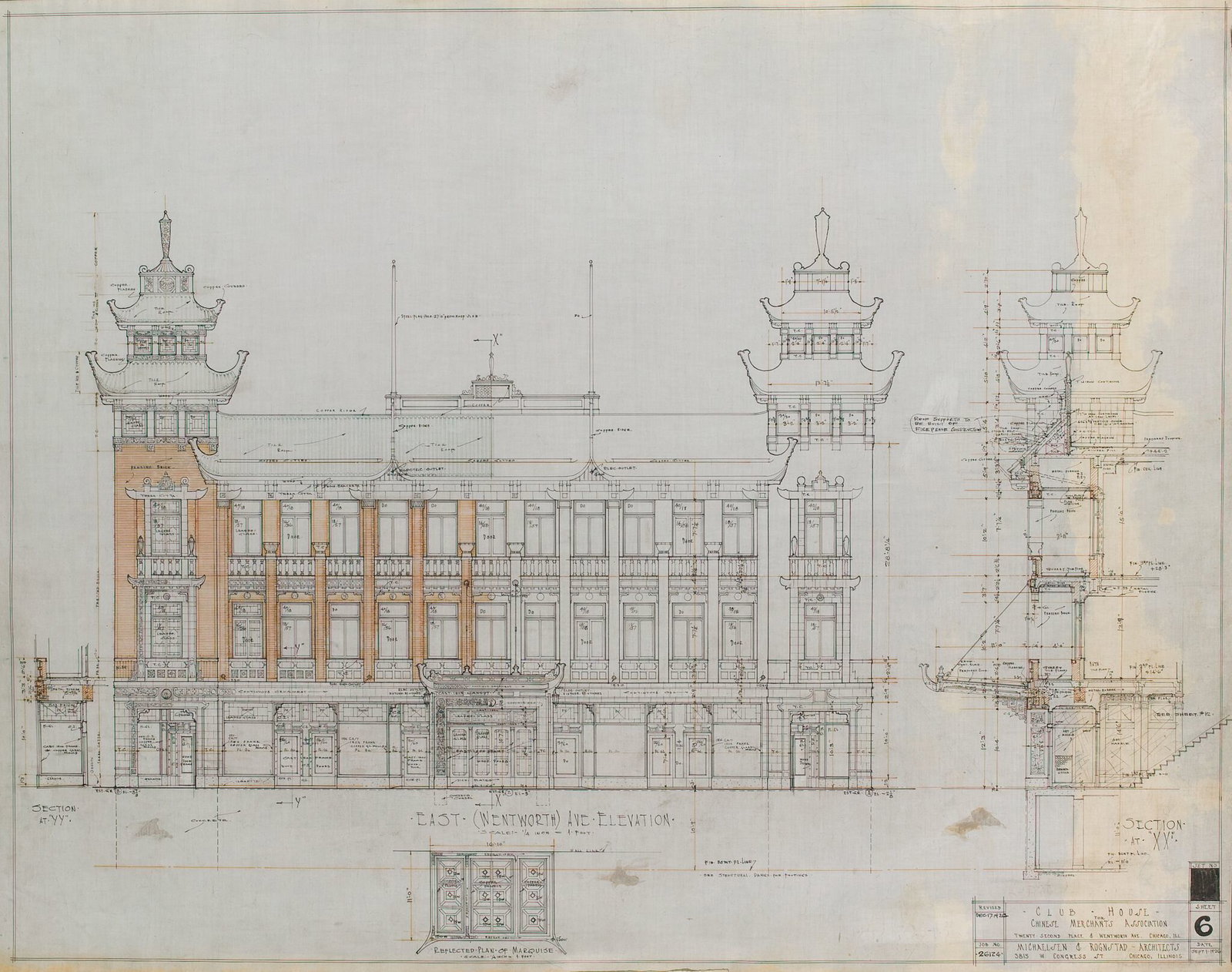
At first, much of the new Chinatown occupied existing buildings, and its streets kept the appearance of the German, Irish and Italian neighborhood that came before. The widening of 22nd Street in 1927, which cost buildings on the south side between Wentworth and Princeton Avenues about 25 feet of their fronts, pushed more businesses onto Wentworth Avenue. The new On Leong headquarters (1926–28) and the Won Kow Building (1927–28) followed, giving the street the Chinese-inspired character many people recognize today.
What remains on Clark Street
Old Chinatown did not vanish at once. Chinese restaurants and businesses stayed on Clark Street for decades. Over the past half century, however, most of the old district was cleared for projects including the Metropolitan Correctional Center, the Ralph H. Metcalfe Federal Building and expansions of the Chicago Board of Trade.
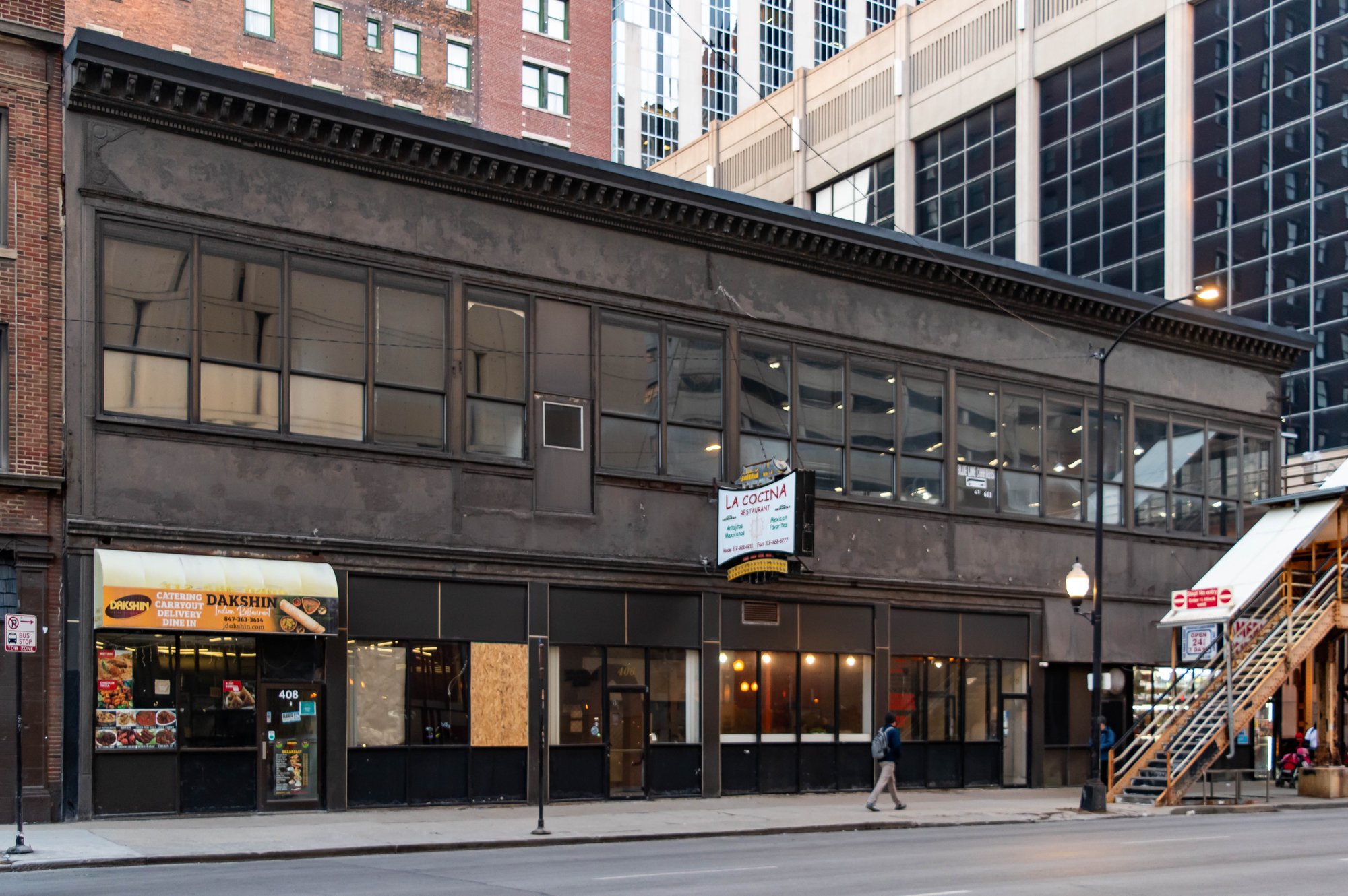
One of the few survivors is the two-story Yukon Building at Clark and Van Buren, designed by Holabird & Roche in 1898. For decades its storefront at 406 S. Clark Street housed the Shanghai Restaurant, run by Howard Dong’s family until the early 1990s and known for its painted murals. A later tenant’s pagoda-shaped sign still hangs over the sidewalk. Preservation Chicago has included what remains of the original Chinatown among its Most Endangered places.
The buildings in today’s survey area are, in part, the continuation of this first Chinatown: the same families, associations, churches and businesses, adapted to a new street.