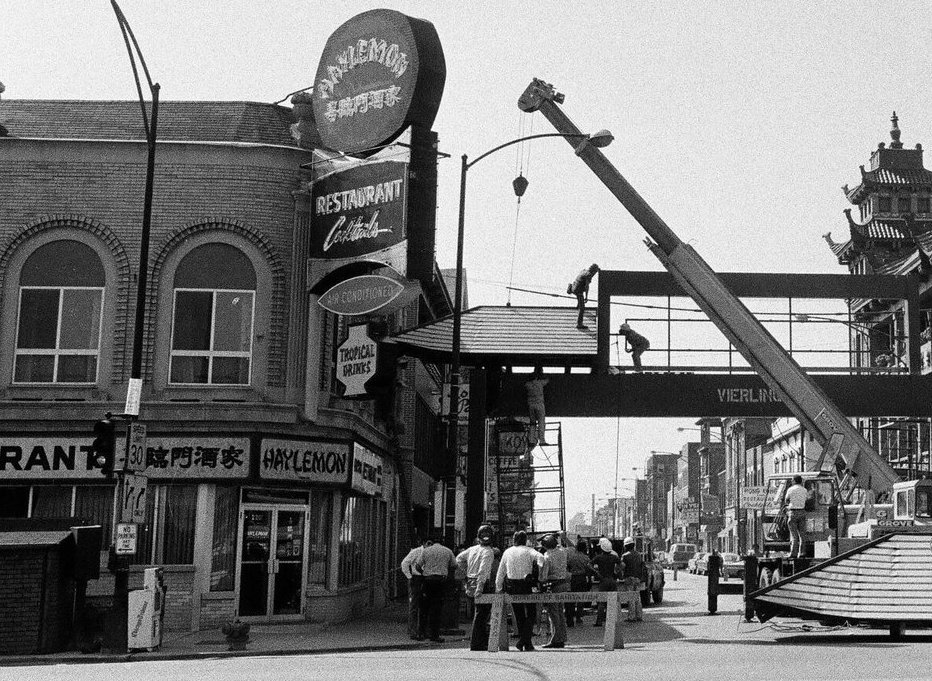
Looking at old photographs, participants kept noticing what was no longer there. Much of what they remembered sat just outside today’s Wentworth and Cermak frontage.
An island
Through their childhood, participants said, Chinatown was boxed in: railroad tracks to the north and west, the expressway to the south, and the elevated line and Amtrak tracks to the east.
“Chinatown was really considered an island, and that’s why things are so expensive there.”
A participant
Wentworth once continued south toward 26th Street, they recalled, past a park and ball field at Harding Square that was lost to the Dan Ryan Expressway. Between Wentworth and the tracks ran LaSalle Street, with a restaurant supply house and a truck yard, where the drum corps practiced.
The blocks north of Cermak
A 1928 view up Wentworth surprised everyone at the table: the east side of the street north of Cermak was lined with buildings. Participants remembered a corner grocery run by a classmate’s family, a pool hall, restaurants down in basements, an import store called the Emporium with a soda fountain, and Overseas Travel, with red and white tile and a pagoda-topped phone booth out front that visitors loved to photograph. As they told it, the blocks were cleared for a Franklin Street extension that never came, and the land became the Chinatown parking lot.
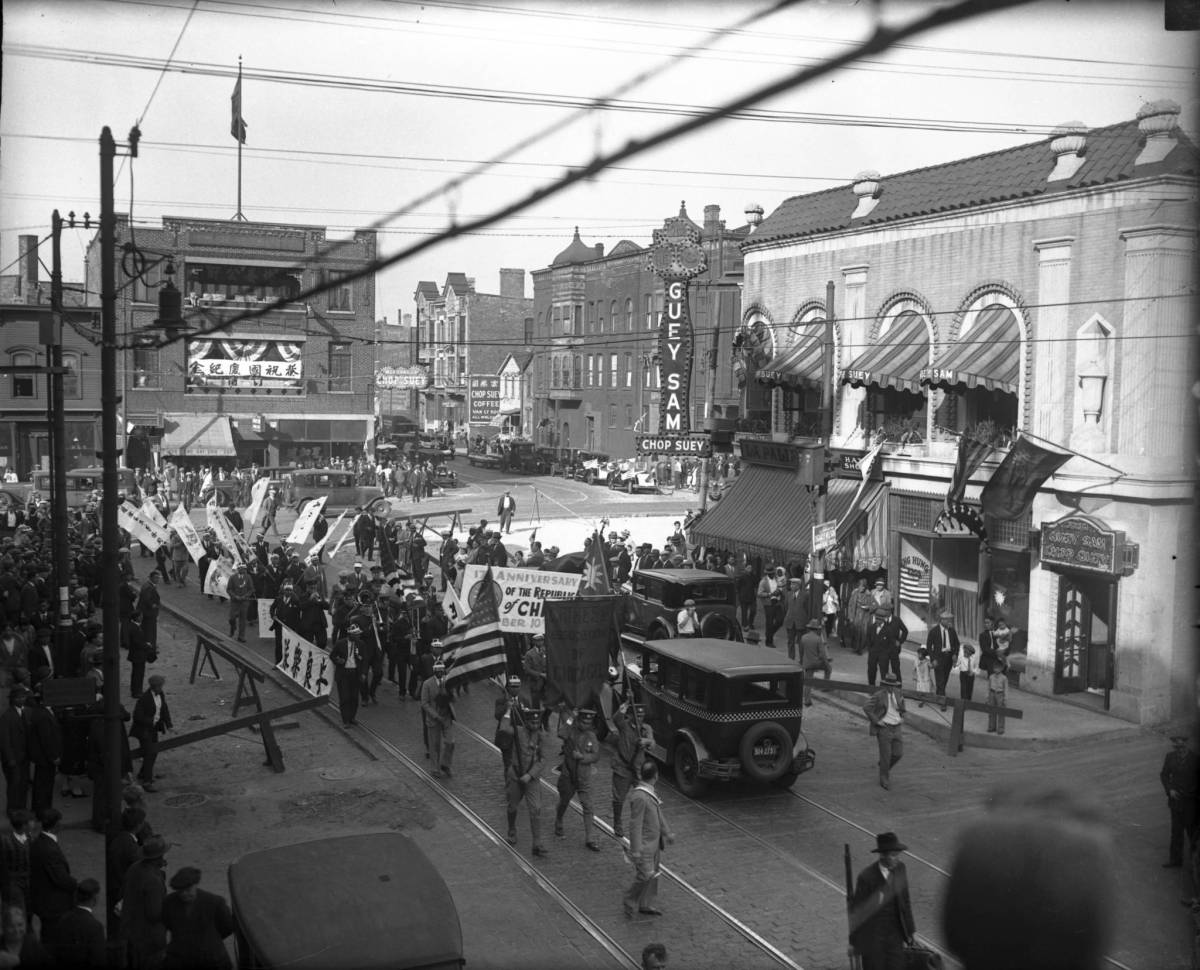
“A lot of business got lost when they just tore this all down and then they didn’t use it for all these years.”
A participant
Closer in, the building that held Dragon Cue, the China Garden restaurant (later Three Happiness) and an association hall was demolished when Wentworth was straightened near Cermak. Within the survey area itself, several remembered places are already gone, including Lucky Coffee Shop at 2221 and Cantonese Chef at 2342, which a Preservation Chicago staff member remembered from Friday dinners as a child.
Customs that faded
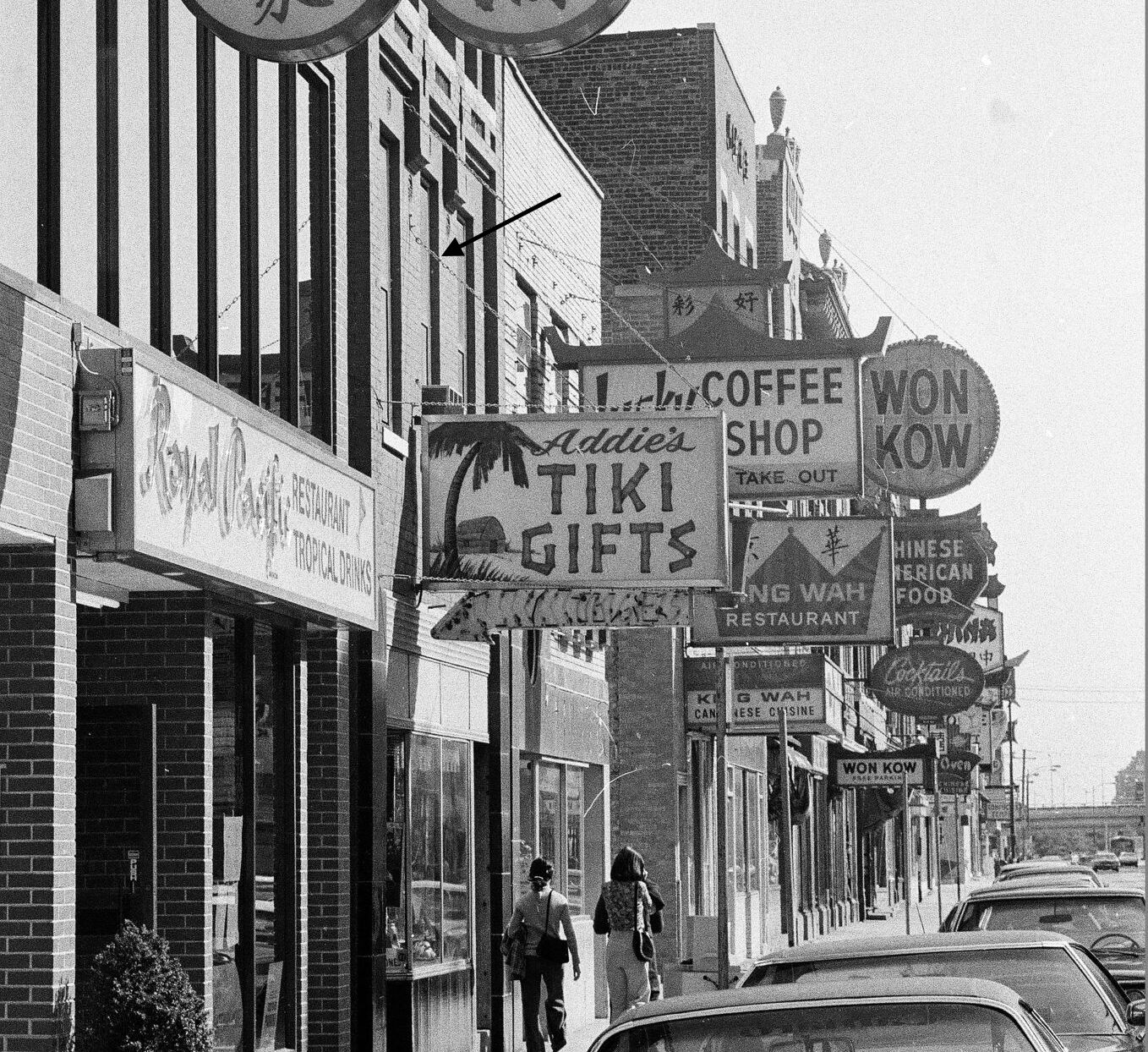
Participants remembered Chinese New Year with strings of firecrackers on nearly every lamppost and storefront, and businesses staging their own lion dances. After a firecracker injured a spectator and led to a lawsuit, they said, the city ended community fireworks; displays now require a licensed outside company. Neon signs have largely disappeared as well. Participants blamed sign rules tied to frontage and the cost of replacement. The Won Kow sign was the exception everyone mentioned.
The Gate, up close
Asked how they felt when the Chinatown Gate went up in 1975, Robert Hoy and Leslie Moy both said, candidly, that they had not cared much at the time. One recalled that the steel came from a fabricator near 23rd Street and Princeton Avenue, and that the original tiles began falling after the first hard winter. A Preservation Chicago staff member noted that the Gate was the first structure in the neighborhood he knew of designed by an architect of Chinese descent.
Spilling over the boundaries
The island did eventually overflow. Participants traced expansion north with Chinatown Square in the mid-1990s and south and west into Bridgeport and along Archer Avenue, a shift they partly credited to one real estate agent who helped the first Chinese families buy homes there. They also noted the long effort to build a second Chinatown on Argyle Street, which is now better known for Vietnamese businesses.
Why designation came up
Near the end, Preservation Chicago staff explained the idea behind a Chinatown landmark district. As they described it, designation is a planning tool focused on what people see from the street, mainly facades and rooflines. It is not meant to freeze buildings as museum pieces; owners could still reinvest, rebuild behind a retained front, or add height set back from the street. The goal is to keep Wentworth and Cermak from becoming “faceless” and to preserve a span of buildings running back to the 1870s and 1880s, some built before Chinatown arrived.
“It’s meant to honor a living legacy.”
Preservation Chicago staff
Robert Hoy and Leslie Moy agreed with the aim but were frank about obstacles. Many owners speak Mandarin or Cantonese and may not engage with English-language outreach. Permits already take months, and one participant expected designation to add scrutiny. Owners pass costs through to tenants, so tenants have the most at stake but no formal say. Participants suggested that owners would need tangible benefits. Staff mentioned the city’s Adopt-a-Landmark fund, which has supported facade restoration on designated landmarks, and floated ideas such as tax relief and expedited permits for interior work behind protected facades.
Staff also hoped that a designation report would gather the stories and names that, as this conversation showed, are held by fewer and fewer people.